
What Is a Brilliant Move in Chess? (And How to Get One)
You have seen the highlight clips. Someone drops a queen onto a defended square, the position collapses three moves later, and an exclamation mark lights up next to the move. Then you sacrifice a knight in your own game, convert the attack, run the review, and the engine hands you a plain Best. Same idea, no medal.
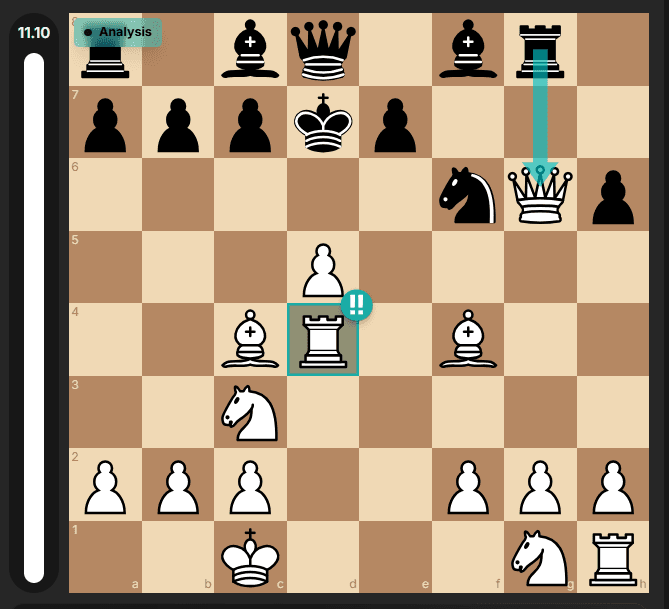
The gap between those two outcomes has a precise explanation. Brilliant is the one grade with a definition strict enough to fit in a sentence: a Brilliant move is the best move in the position that also sacrifices real material. Both halves carry fine print, and the fine print is where most candidate moves fall short. This guide walks through the full test, in the same order the engine applies it.
Requirement One: It Must Be the Best Move
Before the sacrifice question even comes up, your move has to be the strongest one on the board. The review grades each move by how much win probability it gives up against the engine's top choice, and only moves that give up next to nothing qualify as Best. Brilliant is a promotion applied on top of that grade. A sacrifice that ranks second-best in the position stays an Excellent or a Good, no matter how stylish it looks.
This ordering settles the most common question up front: a Brilliant can never be a bad move. An unsound queen sacrifice earns a Blunder, because the label measures soundness before it measures courage.
Requirement Two: It Must Sacrifice Real Material
After your move, at least one of your pieces has to hang. Hanging means your opponent can capture it and come out ahead by about two pawns of material or more once every recapture settles. The engine runs that exchange calculation for each of your pieces, so a bishop that looks loose but costs a rook to take does not count as hanging, while a knight your opponent wins outright does.
The offer also has to cost you something on balance. If your move leaves a knight en prise while forking a rook, the exchange nets in your favor and the engine reads it as a trade wearing a costume. Whatever you hand your opponent must exceed whatever you can grab back.
One more filter surprises people: if capturing the offered piece walks straight into checkmate in each line, the move loses its Brilliant. An offer nobody can accept is a forced combination, and the engine scores it as calculation rather than sacrifice. A real sacrifice leaves your opponent a genuine choice, takes the material and suffers, or declines and suffers differently.
The Disqualifiers
A move can pass both requirements and still miss the label. Each rule below exists to block a cheap Brilliant.
You were already crushing. With an advantage around seven pawns or more, no sacrifice registers. The same applies when a second move in the position also won at that level: giving back material during a mop-up proves nothing, so the engine reserves the grade for positions where the game still hangs in the balance.
The position turns against you. After your move, the evaluation must sit at equal or better from your side. A sacrifice that leaves you worse belongs to a different grade.
The piece was doomed anyway. Leaving a trapped bishop to its fate while you play elsewhere is triage. The engine checks whether each offered piece had squares to run to; a piece with no escape earns no credit, and moving a trapped piece to a new square where it still hangs earns none either.
The piece was already hanging before your move. Material you had left en prise a move ago does not become a sacrifice by staying en prise. The offer has to be created by the move itself.
Mechanical exclusions. Promoting to a queen never qualifies, and neither does a move played while you were in check. Both situations force your hand too much for the choice to mean anything.
Run your rejected knight sacrifice back through this list and the reason tends to jump out. Most often the game was already decided, or the engine ranked a quieter move higher, or the material came back within two moves and the sacrifice was bookkeeping.
The Moves That Set the Standard
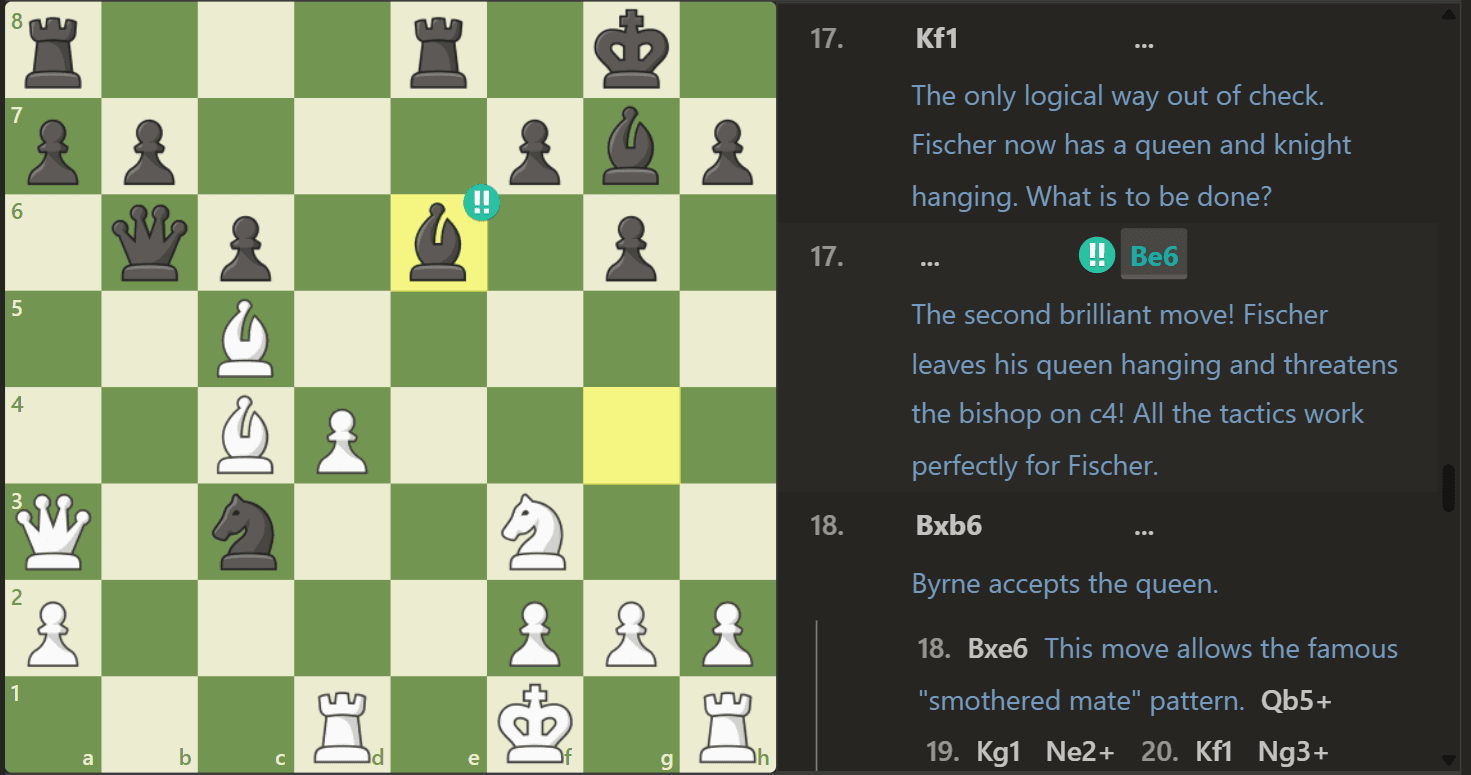
Two classics show what the label was built to capture. Bobby Fischer was thirteen when he played 17...Be6 against Donald Byrne in 1956, leaving his queen to be taken in exchange for a cascade of discovered checks that stripped Byrne's position bare. Frank Marshall finished his 1912 game against Stepan Levitsky with 23...Qg3, placing his queen on a square two pawns could capture; each capture loses on the spot, and the legend says spectators threw gold coins onto the board. Both moves were the strongest available, both gave up the most valuable piece in the game, and in both the position demanded proof before paying out. That is the pattern the modern test formalizes.
How to Earn One
You cannot force a Brilliant, because the position has to offer one first. You can raise the odds of noticing when it does.
Play positions where sacrifices live. Open, attacking games with pieces aimed at a king produce sacrificial chances. Closed, symmetrical positions can go forty moves without one. Your opening choices decide which kind of middlegame you reach.
Check the forcing moves first. Almost all sacrifices begin as a check, a capture, or a threat. Scanning those candidate moves before the quiet ones is the habit that surfaces them, and it costs a few seconds per turn.
Calculate the offer instead of dismissing it. Club players filter out material-losing moves before calculating them, which means the Brilliant candidates never reach the board. When a sacrifice catches your eye, spend the time to refute it. Some refuse to be refuted.
Train the patterns. Greek gift bishops on h7, exchange sacrifices on c3, clearance offers in front of a castled king: these recur because the geometry recurs. Solving puzzles at your level installs the patterns, and pattern recognition is what lets you spot the sacrifice with two minutes on the clock.
Find the ones you missed. Run your games through a free chess analysis after you play. When the engine's best move was a sacrifice you passed over, the review flags the moment, and studying those flagged moves teaches you more than admiring someone else's brilliancy reel. The players who collect Brilliants are the ones who kept looking at positions where they had stopped.
<!--  -->Why Chess.com Gave You One and We Didn't (or the Reverse)
Each site writes its own Brilliant criteria. The core idea travels, a best move plus a sound sacrifice, but the thresholds differ: how much material counts as a sacrifice, how winning is too winning, how the doomed-piece cases get filtered. A move sitting at the edge of the definition falls on different sides on different sites, and neither verdict is wrong. Our test is the one described above, applied the same way to a 400-rated player and a 2400-rated one.
Frequently Asked Questions
Is a Brilliant move always the best move?
Yes. The engine only considers promoting moves that already graded as Best, so the label guarantees soundness. A sacrifice that fails is a Blunder wearing ambition.
Why didn't my queen sacrifice get a Brilliant?
The usual reasons, in order: you were already winning by a wide margin, the queen was capturable without enough compensation until later than the engine credits, another move was stronger, or the material came back at once and the engine scored it as a trade. The disqualifier list above covers the rarer cases.
Do Brilliant moves improve my accuracy score?
A Brilliant counts as a best move, so it costs you nothing, and accuracy has no bonus category. The reward is the label and the win it tends to accompany.
How rare are Brilliant moves?
Rare enough that a hundred strong games can pass without one. The grade needs a sharp position, a sound sacrifice, and a player willing to play it, and those three conditions coincide a few times a year for most club players.
Can I get a Brilliant in a losing position?
No. The evaluation after your move has to be equal or better for you. The one-move-that-saves-everything scenario has its own grade, Great Move, which covers finding the single path that holds.
See If You Have One Buried in Your Games
The fastest way to make the definition concrete is to test your own play against it. Import your recent games, let Stockfish grade each move, and look at the sharp games first. If a Brilliant is in there, the review will find it, and if you passed one up, the Miss it left behind is the most instructive move you will study this week.
Ready to Apply What You Learned?
Put these tips into practice by analyzing your next game with Chess It Up.
Analyze Your Games FreeRelated Articles
Chess Move Classifications Explained: Brilliant to Blunder
What every move grade means — Brilliant, Great Move, Best, Excellent, Good, Inaccuracy, Mistake, Blunder — and how the engine decides which one your move earns.
How to Analyze Your Chess Games Like a Grandmaster
A repeatable method for reviewing your own games: find the moves that decided them, spot your recurring mistakes, and turn losses into rating points.
How to Get Unlimited Chess.com Game Reviews for Free
Chess.com limits you to one free Game Review per day. Review every game you play instead, with move grades, accuracy scores, and Stockfish analysis, without paying.